
FCL vs LCL Caribbean Trade: Cost vs Speed Guide
Choosing between FCL and LCL for Caribbean trade comes down to your shipment size, budget, and urgency. This guide breaks down real cost differences, typical transit times, and when each method wins so you can pick the right option and ship smarter.
Understanding FCL and LCL in Caribbean Trade

What is Full Container Load (FCL) Shipping?
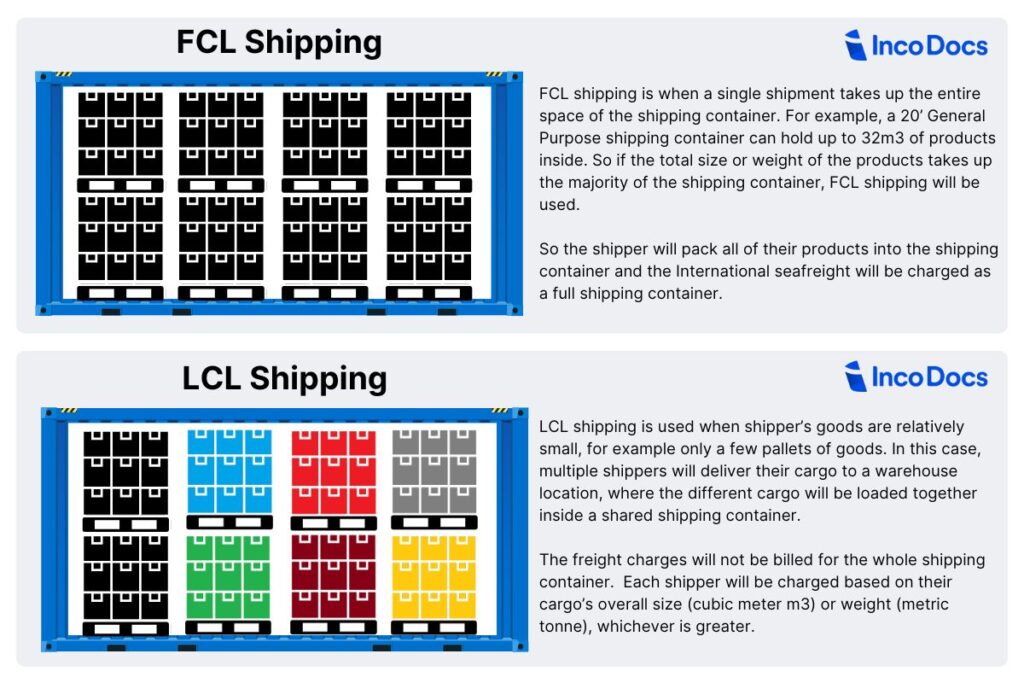
FCL means you get a whole container all to yourself. You can pick a 20-foot box (about 33 cubic meters) or a 40-foot box (about 67 cubic meters). Your goods are sealed at the start and never share space with anyone else’s cargo. I see this used most when a shipment is bigger than 15 CBM. The container moves straight from your loading dock to the vessel, then to the Caribbean port. Fewer people touch it along the way. That direct routing cuts down on delays and damage. For a deeper look at FCL vs LCL Caribbean trade options, check our cost vs speed guide.
What is Less than Container Load (LCL) Shipping?
LCL is the opposite. Many shippers split one container. You pay by the cubic meter (CBM) or by weight—whichever costs more. First, your cargo goes to a Container Freight Station (CFS) near the port. There, workers pack it with other people’s goods into one container. At the destination, another CFS unpacks everything before final delivery. I find LCL works best for small shipments between 2 and 15 CBM heading to Caribbean ports. It lets you move less stuff without paying for an empty box. If you’re weighing speed vs cost in Caribbean shipping, our FCL vs LCL comparison can help.
How These Methods Operate on Caribbean Routes

Freight forwarders handle the booking for both FCL and LCL. Most Caribbean trade flows through big U.S. gateways like Miami, Houston, and Charleston. Common destination ports include Kingston in Jamaica, Santo Domingo in the Dominican Republic, San Juan in Puerto Rico, Bridgetown in Barbados, Port-au-Prince in Haiti, and Nassau in the Bahamas. Here’s the catch with LCL: your cargo may sit at the origin CFS for up to seven extra days waiting for other shippers to fill the container. That wait doesn’t happen with FCL. I rely on forwarders to tell me which lanes have frequent sailings and which ports get backed up. Knowing this helps me pick the right method before I ship. Understanding the trade-offs is easier with a Caribbean trade cost vs speed guide.
| Feature | FCL | LCL |
|---|---|---|
| Volume range | 15+ CBM (20ft/40ft container) | 2–15 CBM |
| Transit time | 3–7 days faster than LCL | 5–10 extra days due to consolidation |
| On‑time reliability | ~95% on regional routes | 85–88% |
| Handling points | 2 (origin dock → destination) | 4+ (pickup → CFS → container → CFS → delivery) |
| Damage risk | Low (single seal, few touches) | Higher (multiple handling, shifting) |
| Customs release | Simple (one bill of lading) | Complex (HBL/MBL – delays if any owner flagged) |
| Cost per CBM | Lower per CBM (flat container rate) | 30–50% higher per CBM than FCL equivalent |
Risk, Handling, and Customs: Protecting Your Shipment
Damage and Security Profiles
- FCL: A single seal stays on from start to finish. Few people touch the box. This cuts the risk of damage. You pack the cargo yourself, so you can brace it well.
- LCL: The cargo gets handled many times. It goes from pickup to a freight station, then to a container, then to the ship, then back to a station, then to you. Each step can cause shifting, crushing, or pilferage.
- For high‑value or fragile items like electronics or medicine, I always pick FCL for Caribbean trade.
- Perishable goods in LCL need a cold room and must have insurance.
Customs Clearance Differences in the Caribbean
- FCL: One bill of lading, one owner. The paperwork is simple. Release is fast.
- LCL: Each shipper gets a House Bill of Lading under a Master Bill. If customs flags one person’s goods, the whole container gets held up. That delays everyone.
- At ports like Santo Domingo and Kingston, LCL often gets extra checks because many owners are inside one box.
- You need a freight forwarder who knows local rules for LCL.
Bill of Lading Types and Their Implications
- FCL uses one straight or negotiable bill.
- LCL uses the HBL/MBL setup. The forwarder, carrier, and all owners must work together.
- A mistake in paperwork can make your cargo sit longer at the port. That costs demurrage fees.
Insurance and Risk Mitigation
- LCL carriers often say you must buy all‑risk insurance. FCL shippers can choose based on what the goods are worth.
- In 2025, many FCL containers use blockchain seals and GPS door sensors for tracking.
- For Caribbean trade, I suggest marine cargo insurance for both modes. Hurricanes and port jams are real risks.
| Risk Factor | FCL | LCL |
|---|---|---|
| Security | Single seal, low pilferage | Multiple handling, higher pilferage risk |
| Damage from shifting | Minimal (you brace your own cargo) | Common (mixed loads shift) |
| Customs delays | Rare (single owner) | Frequent (any owner’s hold-up delays whole container) |
| Insurance recommendation | Optional (choose based on value) | Carrier often requires all‑risk |
| Tracking technology | Blockchain seals, GPS door sensors (2025) | Basic container tracking only |
Decision Framework: How to Choose Between FCL and LCL for Caribbean Trade
Step 1: Measure Your Cargo Volume and Density
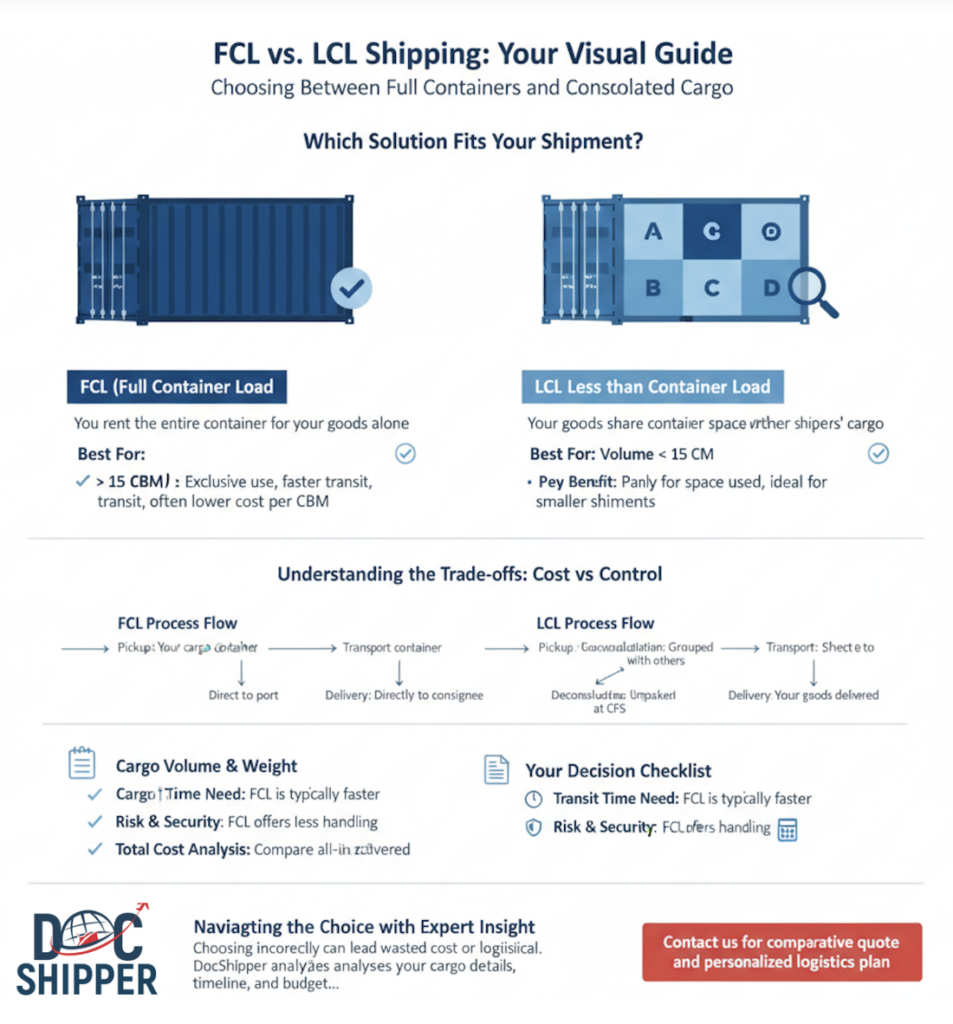
I start by measuring my cargo in cubic meters (CBM). I multiply length by width by height for each pallet or box. Then I check if my goods are heavy like steel or light like clothing. LCL uses the higher of weight or volume to charge. If my total CBM is over 15, I know I should look at FCL first.
Step 2: Factor Transit Urgency and Delivery Window
FCL gets to my Caribbean port 3 to 7 days faster than LCL. FCL has a 95% on‑time record in the region. LCL is 85 to 88% on time. If my customer needs the goods fast, I pick FCL. If I can wait 5 to 10 extra days, LCL works for small loads.
Step 3: Assess Cargo Sensitivity and Value
FCL cargo stays sealed from origin to destination. That means less handling and lower damage risk. I use FCL for fragile electronics, brand items, or high‑value goods. For sturdy things like textiles or non‑perishable food, LCL is fine with good packing.
Step 4: Model Total Landed Cost
I get a flat quote for FCL and a per‑CBM quote for LCL on my lane. I add CFS fees, insurance, customs broker costs, and inland drayage. LCL per‑CBM can be 30 to 50% higher than the FCL per‑CBM equivalent. I use a freight forwarder’s calculator to compare real rates.
Step 5: Consider Seasonal and Market Factors
From October to December, LCL space gets tight and prices spike. I prefer FCL during peak season. From February to April, LCL rates drop and consolidation is faster. I also check Caribbean port congestion alerts; FCL handles delays better.
Step 6: Leverage a Freight Forwarder’s Expertise
A good forwarder helps me switch from LCL to FCL based on my CBM forecast and total cost. They manage consolidation schedules, paperwork, and customs. For Caribbean trade, a forwarder with an office in Miami or Jamaica gives me on‑the‑ground support.
Combination Models for Flexibility
I can use LCL/FCL to combine goods from several suppliers into one full container at origin, then break it down at the Caribbean port. Or I can do FCL/LCL: send one container to a hub like Miami, then split it to multiple islands. This works when I serve several Caribbean markets from one source.
| Decision Step | When to Choose FCL | When to Choose LCL |
|---|---|---|
| 1. Volume | Total CBM > 15 | CBM between 2 and 15 |
| 2. Urgency | Need delivery in < 10 days | Can accept 5–10 extra days |
| 3. Cargo value | High‑value, fragile, or brand items | Sturdy, low‑value goods (textiles, food) |
| 4. Cost comparison | Flat container rate cheaper per CBM | LCL works if shipment is small and FCL waste is high |
| 5. Season | Oct–Dec (peak season, LCL expensive) | Feb–Apr (LCL rates low, consolidation fast) |
| 6. Forwarder support | Use for one‑door paperwork | Essential to manage consolidation & customs |
| You now know FCL beats LCL for large, fast, or fragile loads. LCL fits small shipments and new markets. I showed you the 15 CBM break point. I covered hidden costs and delays. Your choice depends on volume and risk. Use a forwarder for best results. I wish you smooth sailing to the Caribbean. |
References
- https://www.maersk.com/logistics-explained/transportation-and-freight/2023/12/15/understanding-ocean-freight
- https://www.tradefinanceglobal.com/freight-forwarding/fcl-full-container-load-versus-lcl/
- https://interwf.com/services/shipping-container/caribbean/
- https://www.inboundlogistics.com/articles/fcl-vs-lcl/
- https://cargotransinc.com/blog/choosing-between-fcl-and-lcl/
We
Moved 15K+
TEU yearly
Office: RM1708-1711, Hualian Building, No.55 Dongdu Road, Haishu District, Ningbo, China
TEL & WHATSAPP: 86 15058298177
Email: info@aufus-shipping.com